
Scientific Rationale
The near-Earth space environment, with its well-defined boundaries such as the magnetopause and plasmapause, offers a unique laboratory for understanding the interaction between the solar wind and magnetized planetary systems. This interaction is largely governed by two fundamental processes: Kelvin–Helmholtz Instability (KHI) and magnetic reconnection (RX). While RX has been extensively studied due to high-resolution observations by missions like MMS, our understanding of KHI, especially its interplay with RX, remains limited.
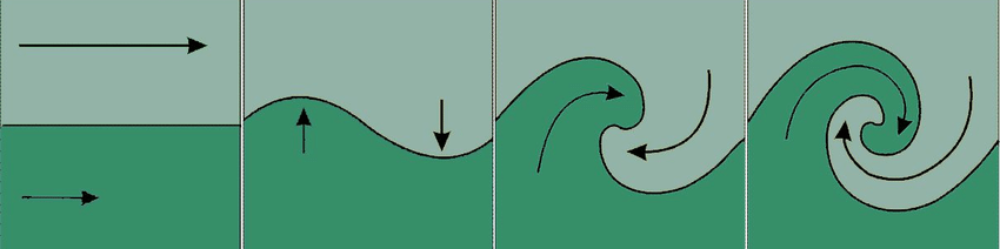
KHIs, driven by velocity shear at boundary layers such as the magnetopause, play a pivotal role in mass, energy, and momentum transfer between the solar wind and Earth’s magnetosphere. These instabilities generate surface waves and vortices, which serve as conduits for processes like plasma transport, heating, and magnetic field topology alteration. Despite its importance, many aspects of KHI dynamics—such as their evolution, their role in energetic particle transport, and their interplay with RX—remain elusive.
Challenges in Understanding KHIs
The complexity of KHI dynamics arises from several factors:
- Multi-scale Coupling: KHI-driven surface waves and vortices exhibit non-linear behaviors, leading to cross-scale interactions spanning fluid, ion, and electron dynamics. This complexity challenges traditional modeling and interpretation.
- Interplay with RX: Recent studies have shown that KHI can trigger RX and vice versa, linking these processes in ways that are not yet fully understood. This linkage suggests that KHIs are not only local phenomena but also drivers of global magnetospheric dynamics.
- Energetic Particle Dynamics: KHIs facilitate the entry and escape of solar wind and energetic particles, impacting magnetospheric structure and dynamics. However, the efficiency and pathways of this transport under varying solar wind and interplanetary magnetic field (IMF) conditions remain poorly quantified.
- Global Implications: KHIs on the magnetopause flanks may causally influence central magnetotail dynamics, potentially impacting current sheet stability and energy dissipation. This relationship has yet to be systematically explored.
Current Gaps and Questions
To advance our understanding, key questions include:
- What are the roles and relative importance of KHI in solar wind transport and magnetospheric dynamics?
- How do KHI-driven processes, such as vortex-induced reconnection and ion-scale wave generation, contribute to plasma heating and particle transport?
- What is the causal relationship between flank dynamics and the stability of the central magnetotail current sheet?
- How does the growth and evolution of KHI vary with external drivers, such as IMF orientation and solar wind velocity?
A Timely Opportunity
With the unprecedented capabilities of current missions like MMS, THEMIS, Cluster, and Geotail, alongside advanced global and local simulation codes, we now have the tools to address these questions. High-resolution data, combined with numerical modeling, offer an opportunity to study the onset, evolution, and implications of KHIs across scales. Furthermore, upcoming missions such as SMILE and BepiColombo will extend these investigations to other planetary environments, enhancing the comparative understanding of KHIs across different plasma systems.
Objectives and Impact
This research aims to:
- Quantify KHI Dynamics: Characterize the conditions and efficiency of KHIs in facilitating solar wind entry, plasma mixing, and energetic particle transport.
- Understand Interplay with RX: Elucidate the mechanisms linking KHIs and RX, including their influence on magnetospheric convection and asymmetry.
- Bridge Observations and Simulations: Integrate observational data with multi-scale simulations to develop a comprehensive model of KHI-driven processes.
- Advance Predictive Capabilities: Provide improved theoretical and observational frameworks for understanding the role of KHIs in space plasma systems.
By addressing these objectives, this work will not only resolve long-standing questions in magnetospheric physics but also provide insights applicable to solar, planetary, and astrophysical plasma systems.