
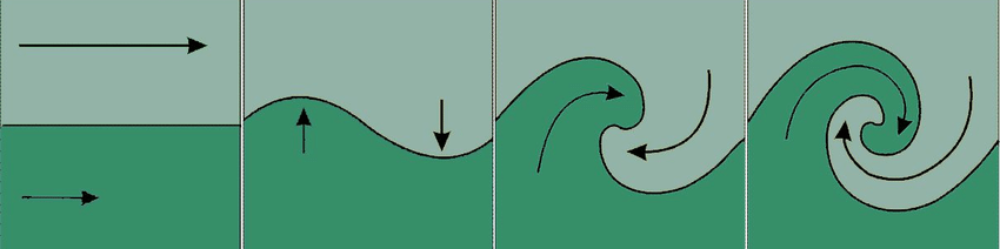
Kelvin–Helmholtz Instabilities (KHIs) play a critical role in space plasma systems, acting as a dynamic channel for solar wind transport, energetic particle escape, and global magnetospheric dynamics. These instabilities, generated by velocity shears at planetary magnetospheric boundaries, are pivotal in understanding the interconnected processes governing the Sun-Earth interaction. They influence vital phenomena such as magnetic reconnection (RX), plasma heating, and ionospheric coupling, making them essential for decoding the more significant heliospheric and astrophysical processes.
Despite recent advancements, the dual nature and interplay between KHIs and RX still need to be explored. To bridge these gaps, our team, leveraging expertise across observational, theoretical, and numerical domains, will:
- Analyze the role and importance of KHI/flank dynamics in solar wind transport and particle energization.
- Simulate and predict the multi-scale dynamics driven by KHIs, identifying observational signatures for verification.
- Investigate the causal relationship between flank dynamics and central current sheet behavior.
This initiative integrates data from cutting-edge missions like MMS, THEMIS, Cluster, and Geotail alongside advanced MHD and hybrid simulation models. Together, we aim to deliver comprehensive insights into the physics of KHIs and their transformative role in space plasma systems.