
First Meeting, 06-10 July 2026, Bern
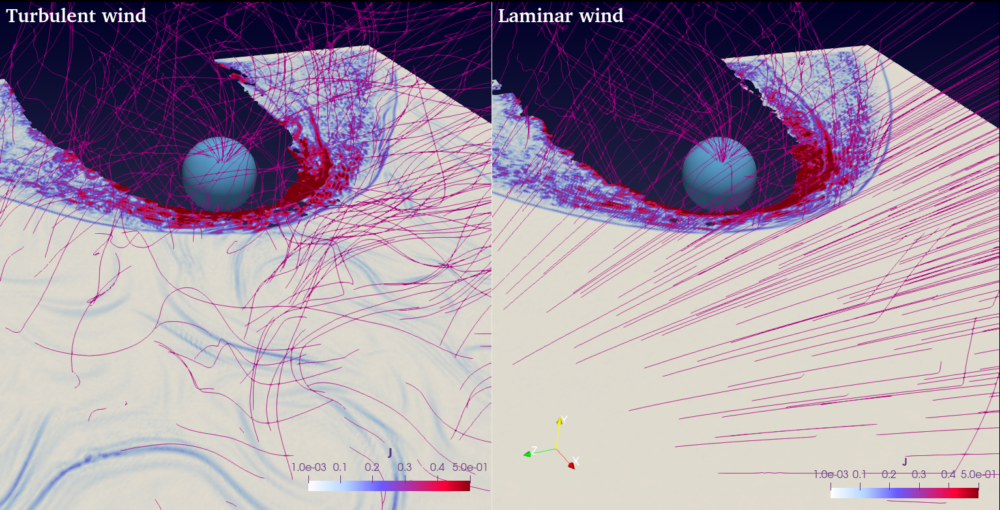
The meeting started with introductory discussions to establish common ground among all team members. These are guided by presentations by all the team members that include an introduction to (i) the relevant numerical codes and simulation results, (ii) available in-situ data from space missions, (iii) state of the art in solar wind turbulence and magnetosphere interactions, and (iv) state of the art on exoplanetary research concerning stellar wind–magnetosphere interactions. We began designing numerical simulations using the hybrid particle-in-cell (PIC) codes Menura and HYPSI to compare them with in-situ spacecraft observations. We started discussing the relevant observational datasets in the heliosphere and identifying suitable events for the team’s studies. An essential aspect of this meeting has been drawing parallels among the planets of the solar system and between solar-system and exoplanetary conditions, which will guide the development of dedicated simulations under exoplanet-like conditions. We devoted the rest of the week to collaboratively identifying knowledge gaps and developing a list of research questions and potential projects. We then prioritized these according to the team’s interests, with particular emphasis on integrating Solar System and exoplanet science. The meeting outcome will be the kickoff of a few collaborative projects to be developed over the coming months. We will monitor the work progress on projects started during the first meeting through regular (monthly) online meetings.
Second Meeting, date to be planned, Bern
We will discuss the work carried out since the first meeting, regarding numerical simulations and spacecraft data analysis. A significant part of the discussions will be dedicated to determining which results are suitable for publication and to outlining the structure of the planned papers. Team members will be encouraged to take the lead on different aspects of the publications, ensuring broad involvement and active collaborations. Considering the growing importance of multi-spacecraft, cross-scale spacecraft missions for heliospheric research, demonstrated by planned (NASA’s Helioswarm) and proposed (ESA’s Plasma Observatory) missions, we will discuss how this future wealth of measurements could improve our understanding of solar/stellar wind turbulence–magnetosphere interactions and how numerical simulations, such as those performed with Menura, can support the interpretation of complex multi-spacecraft datasets and help design future planetary missions.