
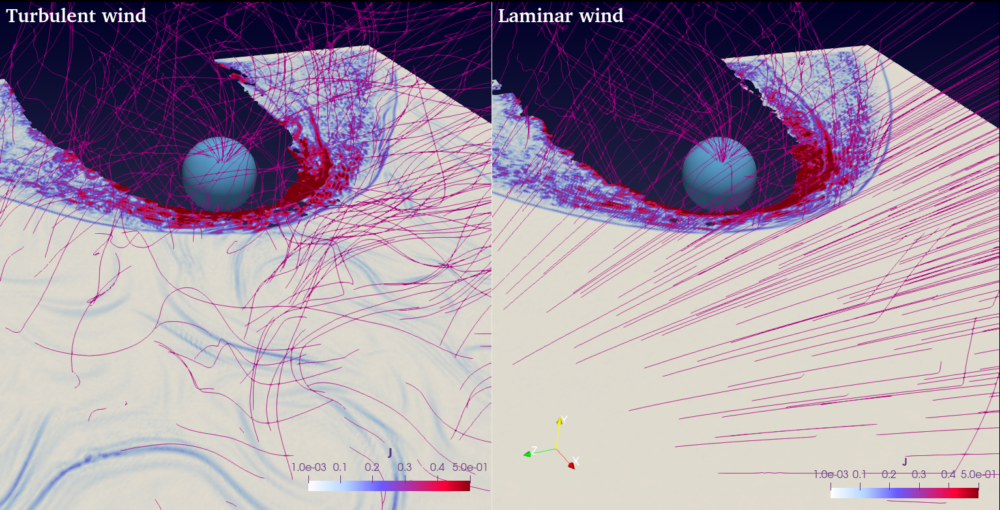
The heliosphere is a region of space influenced by the Sun’s magnetic field, containing the solar wind, a continuous flow of plasma emitted by the Sun. The solar wind is inherently turbulent, with fluctuations spanning a range of temporal and spatial scales. Turbulence dissipates energy, forms structures, promotes magnetic reconnection, amplifies magnetic fields, accelerates particles, and affects shock dynamics.
Numerical simulations, enabled by technological advancements, are increasingly used to study the interaction of the solar wind with planets. However, due to model limitations, the turbulent nature of the solar wind has often been neglected, and it has traditionally been described as a laminar flow, an assumption far from what observations reveal. Recently, a new 3D global kinetic numerical code, called Menura, simulating a turbulent solar wind, has been developed, offering the possibility to simulate a realistic turbulent solar wind interacting with a planetary magnetosphere.
This ISSI team will use numerical simulations and spacecraft observations to investigate turbulence’s role in planetary dynamics. Research tasks will include studying the position and dynamics of planetary bow shocks, changes in the foreshock and magnetosheath regions, and the effects of turbulence on magnetospheres in the solar system and beyond. This team will address the currently unconstrained role of turbulence in wind-planet interactions, proposing a paradigm shift that aims at benefiting both solar system and exoplanetary research.