
THE SUPERMASSIVE STAR CLUSTERS WESTERLUND 1 and WESTERLUND 2
Supermassive star clusters are clusters with masses exceeding 104 M⊙, a threshold at which clusters are dominated by rich populations of massive stars in a compact configuration (Portegies Zwart et al. 2010).
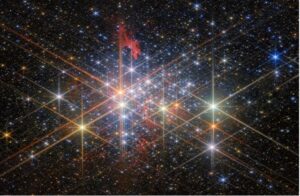
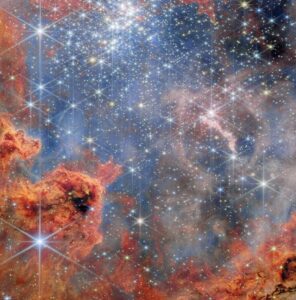
Westerlund 1 and Westerlund 2 are the two Solar-metallicity supermassive star clusters closest to the Sun, located at a distance of approximately 4.2 kpc (Negueruela et al. 2022; Vargas Alvarez et al. 2013; Zeidler et al. 2015), with very young ages of about 5 Myr and 2 Myr, respectively (Kudryavtseva et al. 2012; Vargas Alvarez et al. 2013).
Both clusters are dominated by large populations of massive stars. In particular, Westerlund 1 hosts an extraordinary population of massive stars at various evolutionary stages (Clark et al. 2020), including Wolf-Rayet stars and evolved red supergiants, making it the most extreme star-forming environment known in the Milky Way in terms of energetic radiation and stellar winds. Westerlund 2 also contains a dense concentration of massive stars in its core, including one of the few known binary systems consisting of two Wolf-Rayet WN6 stars (WR 20, Rauw et al. 2004).
|
|
|
THE LOW-METALLICITY STAR CLUSTERS NGC 346 and NGC 602
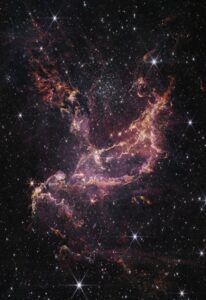
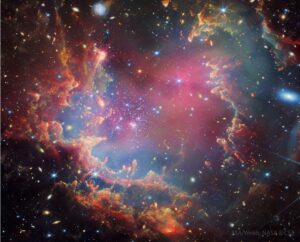
NGC 602 and NGC 346 are young stellar clusters of the Small Magellanic Cloud, which has a metallicity approximately 1/5 of the Solar value. Both clusters are located at a distance of ∼61 kpc (Hilditch et al. 2005).
NGC 602 is situated in the HII region N90, has an age of 2–3 Myr, and a total mass of about 1.3×10³ M⊙ (Cignoni et al. 2009). The nearly coeval cluster NGC 346 (∼3 Myr; Sabbi et al. 2007) is very massive (3.9×10⁴ M⊙; Sabbi et al. 2008) and hosts a rich population of massive stars (Nota et al. 2006). However, it is highly substructured, with up to 15 nearly coeval subclusters. Furthermore, in NGC 602, Zeidler et al. (2024) recently found the first young BD population outside the Milky Way showing that it is possible to explore this mass-regime at low-metallicities using JWST data.
|
|
|
THE DATA
Westerlund 1 and Westerlund 2 have been observed with JWST as part of the Extended Westerlund 1 and 2 Open Clusters Survey (EWOCS; Guarcello et al. 2024). As demonstrated by Guarcello et al. (2025), these observations are deep enough to reach the brown dwarfs limit in both clusters. The data for Westerlund 1 and 2 are already publicly available.
NGC 346 and NGC 602 were observed by JWST during Cycle 1, and their data are already public. Additionally, new very deep JWST NIRCam imaging and NIRSpec Multi-Object spectroscopiy observations of NGC 602 have been approved (JWST-7035, PI: P. Zeidler) and will become available toward the end of the project. Observations of all four clusters were conducted using similar strategies, utilizing both NIRCam and MIRI in photometric mode with a wide set of filters.