
 |
 |
 |
|
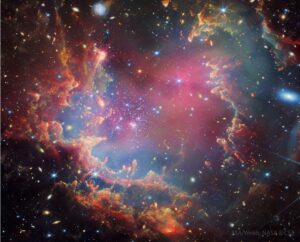
ISSI Team 25-639 has one primary objective: to understand whether the products of star formation are universal or if they are affected by the star-forming environment.
The mass distribution at birth of a stellar ensemble, known as the Initial Mass Function (IMF), is one of the most fundamental concepts in stellar astrophysics. For instance, it is strictly connected to the physics of star formation and serves as a vital tool for modeling unresolved stellar populations in distant galaxies.
The central question we aim to answer is: Are the Initial Mass Function and the production efficiency of very low-mass stars and brown dwarfs truly universal, or can they be influenced by the environment in which stars form? (e.g.: Offner et al. 2014)
The two forms of environmental feedback we are investigating are:
-
The presence of rich populations of massive stars.
-
The metallicity of the star-forming environment.
Massive stars produce huge amounts of UV radiation and energetic particles that impact the physical properties of surrounding clouds across distances of several parsecs. Changes in gas temperature and density are expected to affect the gravitational collapse and fragmentation of the parent cloud, thereby dictating the ultimate products of the star formation process (e.g. Krumholz 2006, Whitworth et al. 2007).
Metallicity—the abundance of elements heavier than helium relative to hydrogen—dictates the coupling of collapsing clouds with incident radiation and determines the amount of dust available for star formation. This, again, impacts the physical properties of the collapsing cloud and thus, in principle, the products of star formation (e.g.: Guszejnov et al. 2022, Sharda & Krumholz 2022).
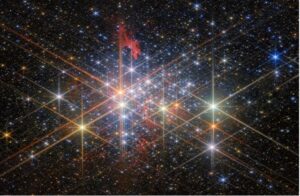
The team activity is part of the Extended Westerlund 1 and 2 Open Clusters Survey (EWOCS, Guarcello et al. 2024)