
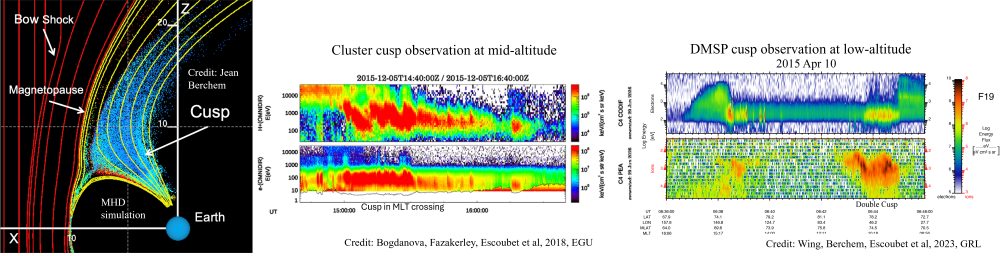
Earth’s magnetospheric cusps play a critical role in the energy and plasma flow from the solar wind to the magnetosphere and ionosphere, being the first points of solar wind plasma entry into the near-Earth space due to reconnection between Interplanetary Magnetic Field (IMF) and geomagnetic field lines. The cusp regions and spatiotemporal variability of magnetic reconnection have been extensively studied. However, many questions remain.
The proposal brings together scientists from the data analysis and modelling communities to advance our knowledge of the cusp regions. We aim to study:
1) the characteristics and sources of the medium- and small-scale plasma fluctuations observed in the cusp and the energy flow partition between different scales and processes within the coupled global system;
2) the longitudinal complexity and variability of the cusps in relation to the magnetopause reconnection geometries;
3) the consequences of intrinsic asymmetries observed in the magnetosheath and the magnetosphere on the energy and plasma transport in the system.
These research goals will be addressed by analysing conjugated observations with Cluster inside the mid-altitude cusp, THEMIS or MMS in the magnetosheath, and DMSP or Swarm satellites in the low-altitude cusp. Our comprehensive approach is novel by covering all areas of the coupled system, including sources and sinks of the plasma populations within the cusp, Field-Aligned Currents (FACs), plasma energy fluxes, and Poynting flux.
Results of the project will greatly contribute towards our knowledge of the solar wind-magnetosphere-ionosphere coupling and towards defining further research goals for TRACERS, SMILE, and Bepi Colombo missions.