
In March 2023, we had our first ISSI in-person meeting in Bern.
We discussed:
– An overview of each GCM and a comparison of the “chemistry-free” results
– Discuss and decide on the chemical and radiation schemes
– Discuss the details and challenges in implementation
We have finalized the benchmark tests as follows:
Test description:
Model boundaries:
– The lowest layer needs to be at least 100 bar. Use convective adjustment.
– Use approximately 2-4 degrees or equivalents for the horizontal resolution
– Use the least damping and sponge layers that can keep the simulation stable
Test 1 (passive tracer):
0. Run the nominal GCM until the steady state
1. After the steady state has been achieved, initializing passive tracers from the dayside equatorial region below 1 bar: for the region below 1 bar, +/- 30 degree longitude and +/- 30 degree latitude, fix a uniform mixing ratio of passive tracers from.
2. Report 0, 1, 50, 100 days after the tracers are initialized
(In practice, Test 1 is embedded in Test 2 using an inert gas)
Test 2 (double-grey with mini-chem):
0. Run the nominal GCM until the steady state
1. Use the following constant opacities:
kappa_IR = 0.003, kappa_shortwave = 0.00085 (m^2 kg^-1)
2. For internal heating, relax the temperature at the bottom toward the temperature given by an adiabat with Tint = 350K. A relaxation time of 10^5 sec is used in Steinrueck 2023 but choose whatever works better. In the case that the temperature relaxation at the bottom is difficult to implement, use Tint = 350 K internal flux instead.
3. After the steady state has been achieved, include the chemical tracers.
Test 3 (correlated-k with mini-chem):
This is the same test as Test 2, but the correlated-k opacities are used for the RT.
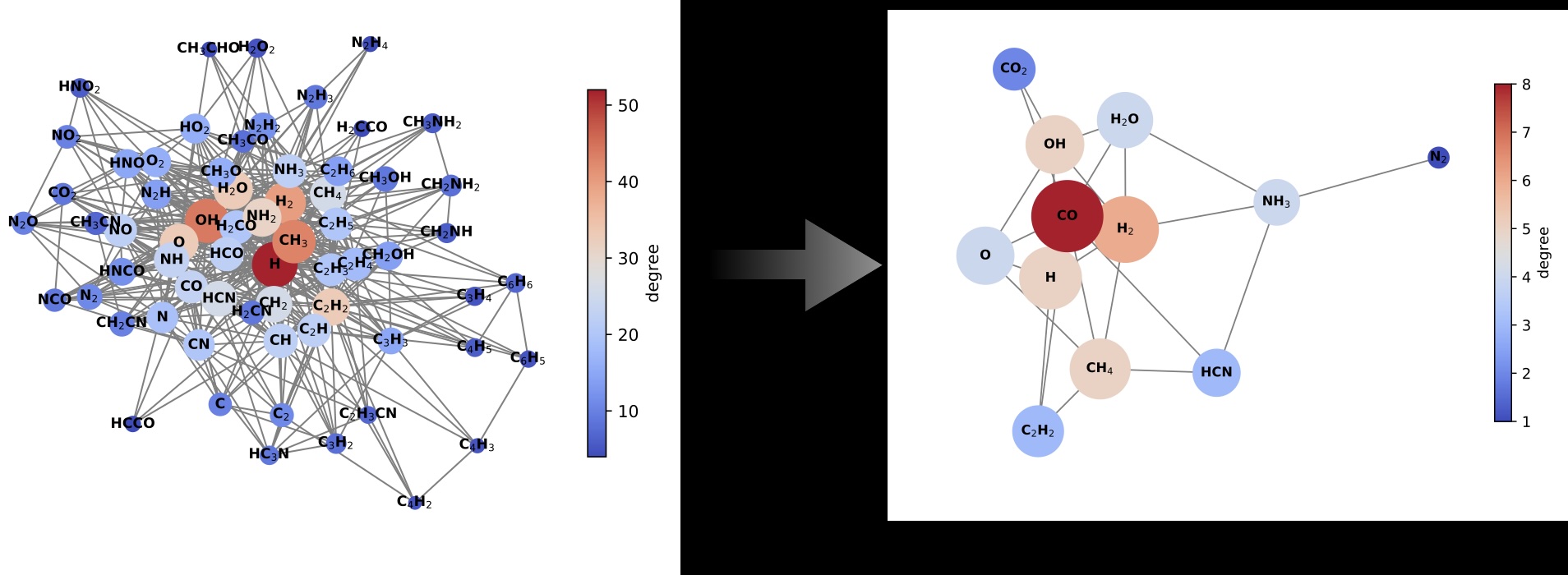
The “mutual species” among all models to include are:
– Na
– K
– CO2
– CH4
– NH3
– CO
– HCN
– CIA H2-He
– CIA H2-H2