
During solar flares, a substantial increase in ionisation occurs in the sunlit portion of the Earth’s ionosphere. This often disrupts modern navigation and communication systems and, therefore, significantly impacts our everyday lives. Although modern research methods have advanced our understanding of the general trends in ionospheric dynamics under solar flares, our knowledge of the vertical redistribution of ionospheric constituents and its relationship to flare spectral composition remains limited. This gap is primarily due to the difficulty of obtaining altitude-resolved experimental measurements, the insufficient validation of theoretical models, and the lack of collaboration between modellers and observers. An unprecedented dataset of spectrally distinct X-class flares was obtained using modern instrumentation during the peak of Solar Cycle 25. Combined with the diverse expertise assembled through the ISSI workshop framework, this effort provides a unique opportunity to gain fundamentally new insights into ionospheric responses to solar flares.
This project brings together leading international researchers in solar-terrestrial modelling and observations to conduct a multi-instrument study of ionospheric layer responses to solar flares. Based on a validated methodology, extensive use of solar and ionospheric observations, and the incorporation of theoretical models of different ionospheric layers, this team will develop a verified practical tool for forecasting altitude-dependent electron density dynamics during solar flares with various spectral properties.
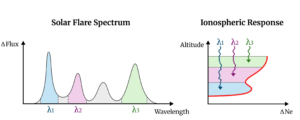
The main goal of this ISSI Team is to conduct a comprehensive multi-instrument investigation of the relationship between vertical electron density redistribution in the ionosphere during solar flares and the spectral composition of these events. The study will analyse major series of X-class solar flares that occurred in 2024-2026.
CONTACTS: Susanna Bekker (s.bekker@qub.ac.uk), Aisling O’Hare (aohare32@qub.ac.uk)