
The ATTACK team gathered for its second, hybrid, meeting in Bern during the first week of June 2026, including the core members, multiple Early Career Scientists, as well as guest colleagues who were interested by our team’s theme and contributed remotely. Our activities comprised of the presentation of multiple studies relevant to the team’s research topics and the extensive discussion of further actions to be followed. Our current results encompass experimental and theoretical investigations for the chemical and photo-dissociative processes in Titan’s upper atmosphere, novel analyses for the characterization of Titan’s gas and haze composition from Cassini and JWST observations, updated photochemical models including isomer-specific abundances and estimates for the formation of polyaromatic hydrocarbons, as well as, experimental and theoretical investigations for processes occurring on haze and cloud particles in Titan’s atmosphere.
The combination of these studies expands the frontiers of our understanding of physical and chemical processes on Titan: they permit the evaluation of the gaseous abundances of previously non-considered species in the atmosphere that can be cross correlated against unidentified features in current observations or be used for the derivation of abundance upper limits; they extend the current understanding in the transition from gases to particles in the upper atmosphere; and they illuminate the interplay among haze, gases and clouds while identifying novel mechanisms for the possible treatment of ices by high-energy radiation. Moreover, while our research topic focuses on Titan’s atmosphere and surface, our activities have broad implications for planetary atmospheres in general, including exoplanets (as demonstrated in our publications). Our so far activities have resulted in multiple publications, while further collaborative studies are currently underway.
This second meeting marks the end of the ISSI related activities for our team. We are grateful to the ISSI organization for this unique collaboration opportunity, and we warmly thank Mark, Sabina Raducan, Cosima-Lea Baier, Xeila Moneagudo, Dominique Fuchs and Willi Wäffler for their outstanding hosting and assistance that helped us advance in our common research interests.
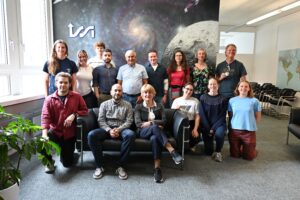
Participants
|
Daniela Ascenzi
|
University of Tronto |
Guest | Remote |
| Nadia Balucani |
University of Perugia |
Core | remote |
| Audrey Chatain |
LATMOS |
Core | in person |
| Athena Coustenis |
Observatoire de Paris |
Core | in person |
| Antoine Damiens |
Université Reims Champagne Ardenne |
ECS | remote |
| Joshua Ford |
University of Bristol |
ECS | in person |
| Elle Hanson | University of Amsterdam | ECS | in person |
|
Elsa Henault
|
Université Grenoble Alpes | ECS | in person |
| Devin Hoover | University of Arizona | ECS | remote |
|
David Jacquemart
|
Sorbonne Université | Guest | remote |
| Panayotis Lavvas |
Université Reims Champagne Ardenne |
Core | in person |
| Nathan Le Guennic |
Université Reims Champagne Ardenne |
ECS | in person |
| Jonathan Lunine | Caltech | Guest | remote |
| Ashleigh Hartwig |
Florida International University |
ECS | in person |
| Zachary McQueen |
NASA GSFC |
ECS | in person |
| Alexander M. Mebel |
Florida International University |
Core | in person |
| Conor A. Nixon |
NASA GSFC |
Core | in person |
| Anezina Solomonidou |
Hellenic Space Center |
Core | remote |
| Nick Teanby |
University of Bristol |
Core | in person |
| Sandrine Vinatier |
Observatoire de Paris |
Core | in person |
| Véronique Vuitton |
Université Grenoble Alpes |
Core | in person |