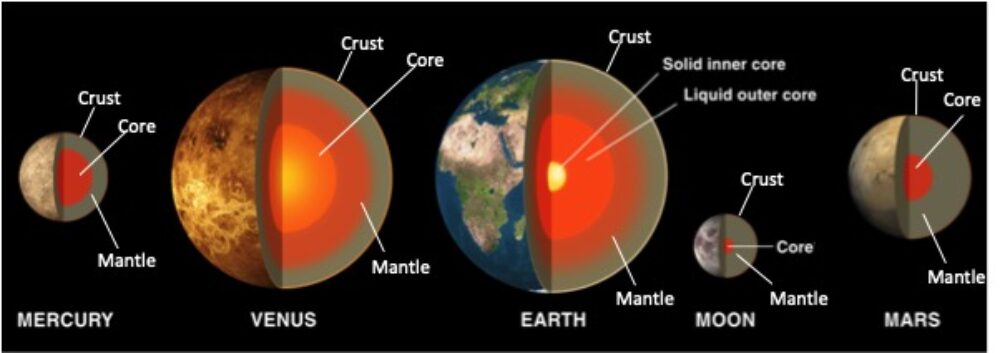
The structure of the crusts, mantles, and cores of planets holds clues to their thermal state and chemical composition, and, in turn, their origin and evolution. Geophysical techniques probe Earth’s deep interior and have revealed its inner workings, including processes such as plate tectonics, mantle convection and the solidification of Earth’s core. A number of developments, including new seismic models with refined uncertainties that suggest a denser terrestrial outer core, machine learning-based methods for computing core and mantle properties and advances in the number and precision of laboratory-based measurements, have opened the possibility for improving our understanding of terrestrial planet interiors across all scales; from the Earth and Mars to small differentiated bodies like the Moon and Vesta. In view hereof, we propose to assemble an international multi-disciplinary team on the topic of the structure and composition of terrestrial planetary interiors. By uniting seismology, geophysics, experimental and theoretical mineral physics, with geo- and cosmochemistry, we will shed light on the origin of the terrestrial planets. While focused on our solar system, we anticipate that insights will reach beyond, to extra-solar planetary systems. Data that will be analysed as part of the research to be conducted, include both data from ground and space and satellite missions (e.g., Lageos, Insight, Apollo) and the results will inform models for upcoming missions, including BepiColombo (Mercury) and the lunar Farside Seismic Suite.

Structure and composition of planetary cores and mantles
ISSI Team 25-645 led by Khan A. & Sossi P.