
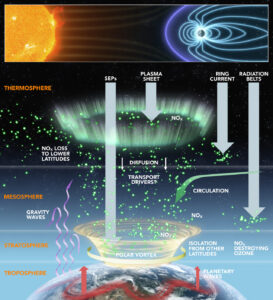
The contribution of auroral precipitation to ozone changes in the middle atmosphere
Energetic auroral precipitation, such as from pulsating aurora, can cause production of nitric oxides (NOx) in the mesosphere and lower thermosphere (MLT) that then can descend downwards to the stratosphere. These processes are depicted in the figure shown here. When the NOx reaches the middle atmosphere, it can catalytically destroy ozone, leading to significant losses. The effect is particularly efficient in the polar night, because the NOx lifetimes are long and allow for time to descend deep into the stratosphere. Studies have shown months-long ozone depletions due to a single, intense pulsating aurora event. The mechanism by which the downward transport of NOx takes place is enhanced by the polar vortex, a large circumpolar cyclone in the middle atmosphere that typically forms in the fall and can be effected and disrupted by planetary waves. This exact mechanism is related to traveling planetary waves in the upper mesosphere: they have been shown to enhance NOx descent in regionally-confined longitude bands in planetary wave troughs. However, the extent to which MLT NOx is enhanced when regionally-confined NOx sources coincide with planetary wave troughs has yet to be explored. To determine the rate at which energetic auroral precipitation can affect ozone, it’s crucial to understand the overlap between pulsating aurora occurrence, the mesospheric polar vortex, and the effects of planetary waves on its location.
Artist credit: Andy Kale