
Abstract
Among the many threats posed by global warming, potential changes in the Atlantic meridional
overturning circulation (AMOC) and sea-level rise loom large. Reduction in the AMOC’s heat transport
could alter hurricane activity, rainfall patterns, and land temperatures, while sea-level rise would cause
coastal flooding, loss of wetlands, and beach erosion. What’s more, ocean circulation and sea level are
coupled. We must understand how and why AMOC and sea level have changed in the past, and how those
changes were related, to project future changes and impacts.
Models project that the AMOC will decline or possibly collapse in the next century, and North
Atlantic coastlines will witness enhanced sea-level rise as a result. Yet, it is difficult to determine how
realistic these projections are. There is debate about whether AMOC has significantly changed since the
Industrial Revolution, because direct AMOC records are short in time and sparse in space. Hence, no
authoritative observational benchmark exists for comparing with long-term historical AMOC simulations
from models that are also used to project future changes, including of sea level.
We propose to convene a diverse, interdisciplinary Team to use data, modeling, and theory to
study the relationship between the AMOC and sea level, and to quantify the value sea-level data add to
ocean observing systems. Our proposal is timely given recent advances in space-based observations, data
processing algorithms, and the need to find alternatives for expensive in-situ AMOC monitoring arrays.
Results may inform historical AMOC reconstructions and projections of impacts from climate change.
Motivation
|
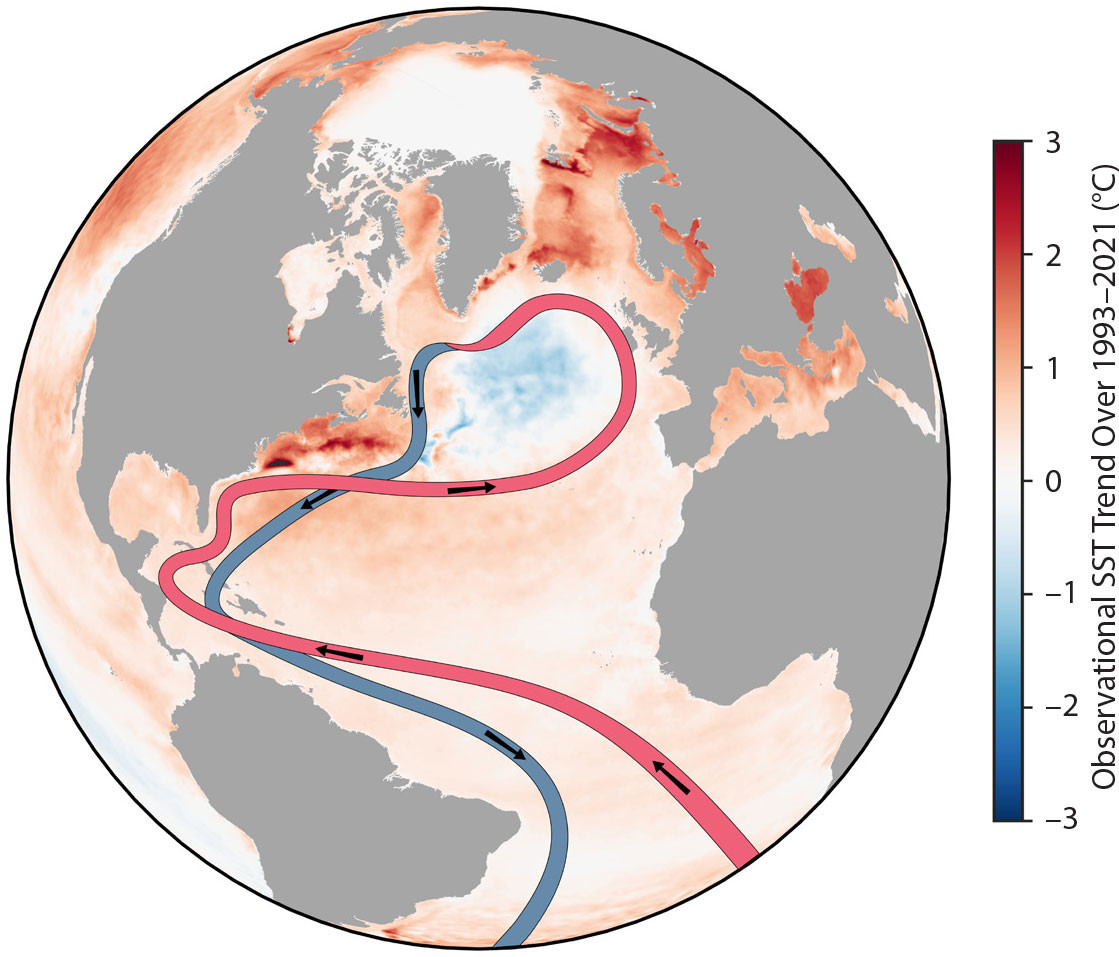
The AMOC defines a collection of currents in the Atlantic that transports warm near-surface waters north to high latitude. This northward ocean heat transport plays a crucial role in climate, contributing to the mild climate experienced in northwestern Europe [1], abrupt climate changes during Earth’s past [2], and variability in a range of societally relevant global climate processes including hurricane activity, rainfall patterns, and surface air temperatures [3]. The latest Intergovernmental Panel on Climate Change Assessment Report concludes that the AMOC will very likely decline in the 21st century and global sea level will almost certainly continue rising until at least 2100 due to ocean warming and ice melting [4]. However, it remains unclear how quickly and by how much AMOC will weaken, if the AMOC will collapse, and how much coastal sea level will rise regionally due to changing ocean dynamics. |
Figure: Highly simplified schematic of the Atlantic Meridional Overturning Circulation (AMOC) against a backdrop of the sea surface temperature trend since 1993 from the Copernicus Climate Change Service (https://climate.copernicus.eu/). Image credit: Ruijian Gou. [5]
|
|
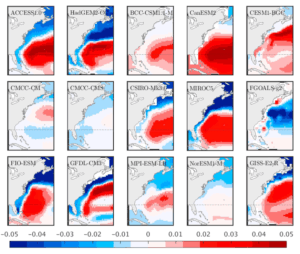
Figure: Map of the ratio of dynamic sea level change to AMOC change (m/Sv; 2076–2100 minus 1976–2000) for 25 RCP4.5‐forced Coupled Model Intercomparison Project Phase 5 models with AMOC weakening larger than 2 Sv (from [6])
|
This uncertainty in the relationship between changes in the AMOC and associated dynamical sea-level (SL) variations along the U.S. East Coast is reflected in the spread of climate model simulations. Most long climate simulations are also generated by coarse models lacking the spatial relationship between the Atlantic meridional overturning circulation and coastal sea level resolutions needed to properly represent important bathymetric, frictional, and local forcing effects over the shelf and slope that mediate the coastal ocean response to open-ocean variability. Observational evidence of an AMOC-SL relationship is also limited, because direct continuous measurements of the AMOC are short and only exist across two latitude lines in the North Atlantic. Therefore, AMOC changes at other latitudes or during earlier times are unclear (e.g., 7, 8, 9, 10) and whether the AMOC is undergoing or has undergone major changes since the Industrial Revolution is an ongoing debate. |
|
These open questions motivate a dedicated study of the relationship between the AMOC and sea |
Q1) What is the relationship between coastal sea level and components of the AMOC?
|
References:
[1] Palter, J. B. (2015). The Role of the Gulf Stream in European Climate. In Annual Review of Marine Science (Vol. 7, Issue 1, pp. 113–137). Annual Reviews. https://doi.org/10.1146/annurevmarine-010814-015656
[2] Lynch-Stieglitz, J. (2017). The Atlantic Meridional Overturning Circulation and Abrupt Climate Change. In Annual Review of Marine Science (Vol. 9, Issue 1, pp. 83–104). Annual Reviews. https://doi.org/10.1146/annurev-marine-010816-060415
[3] Zhang, R., Sutton, R., Danabasoglu, G., Kwon, Y., Marsh, R., Yeager, S. G., Amrhein, D. E., & Little, C. M. (2019). A Review of the Role of the Atlantic Meridional Overturning Circulation in Atlantic Multidecadal Variability and Associated Climate Impacts. In Reviews of Geophysics (Vol. 57, Issue 2, pp. 316–375). American Geophysical Union (AGU). https://doi.org/10.1029/2019rg000644
[4] Fox-Kemper, B., et al., Ocean, Cryosphere and Sea Level Change. (2023). In Climate Change 2021 – The Physical Science Basis (pp. 1211–1362). Cambridge University Press.https://doi.org/10.1017/9781009157896.011
[5] Rahmstorf, S. 2024. Is the Atlantic overturning circulation approaching a tipping point? Oceanography 37(3):16–29, https://doi.org/10.5670/oceanog.2024.501.
[6] Little, C. M., Hu, A., Hughes, C. W., McCarthy, G. D., Piecuch, C. G., Ponte, R. M., & Thomas, M. D. (2019). The Relationship between U.S. East Coast sea level and the Atlantic Meridional Overturning Circulation: A review. Journal of Geophysical Research: Oceans, 124, 6435–6458. https://doi.org/10.1029/2019JC015152
[7] Chafik, L., & Lozier, M. S. (2025). When Simplification Leads to Ambiguity: A Look at Two Ocean Metrics for the Subpolar North Atlantic. In Geophysical Research Letters (Vol. 52, Issue 3). American Geophysical Union (AGU). https://doi.org/10.1029/2024gl112496
[8] Frajka‐Williams, E. (2015). Estimating the Atlantic overturning at 26°N using satellite altimetry and cable measurements. In Geophysical Research Letters (Vol. 42, Issue 9, pp. 3458–3464). American Geophysical Union (AGU). https://doi.org/10.1002/2015gl063220
[9] Jackson, L. C., Biastoch, A., Buckley, M. W., Desbruyères, D. G., Frajka-Williams, E., Moat, B., & Robson, J. (2022). The evolution of the North Atlantic Meridional Overturning Circulation since 1980. In Nature Reviews Earth & Environment (Vol. 3, Issue 4, pp. 241–254). Springer Science and Business Media LLC. https://doi.org/10.1038/s43017-022-00263-2
[10] Lobelle, D., Beaulieu, C., Livina, V., Sévellec, F., & Frajka‐Williams, E. (2020). Detectability of an AMOC Decline in Current and Projected Climate Changes. In Geophysical Research Letters (Vol. 47, Issue 20). American Geophysical Union (AGU). https://doi.org/10.1029/2020gl089974